
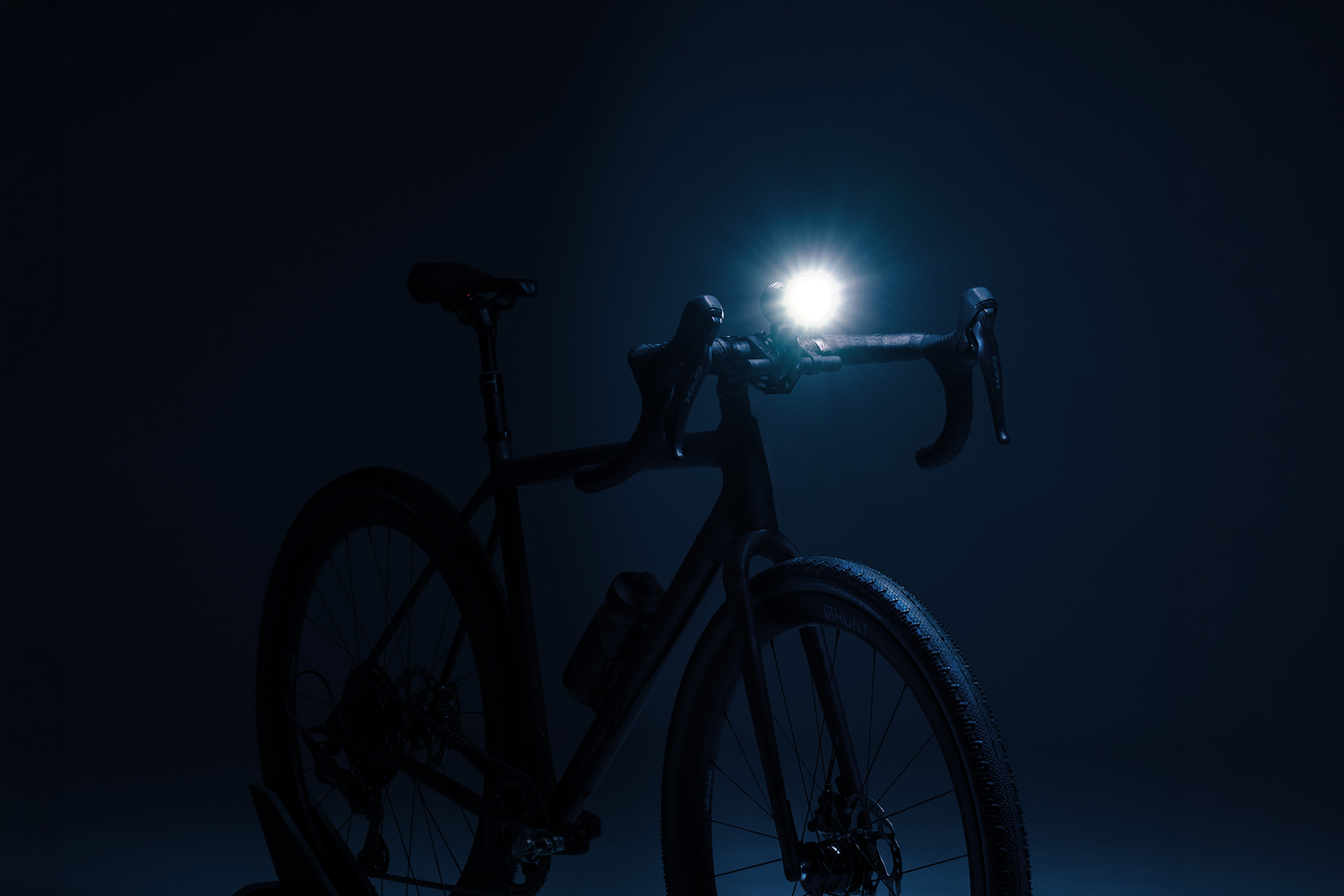
Quick answer: it depends on your riding. Technical mountain bike descents call for 2,000 to 6,000 lumens. Fast road riding needs 1,000 to 1,700 lumens with auto-dimming for oncoming traffic. Bikepacking and gravel need just 200 to 450 lumens. And on lit urban roads, around 300 lumens is ideal.
When it comes to night riding, there is much debate about how much light, or how many lumens, you actually need.
Universally, bike lights and headtorches have all got brighter over the years. Exposure Lights are no different; our first Six Pack delivered 900 lumens at its brightest, that figure is now 6,000 lumens. Incremental improvements in LED and battery technology, alongside constant developments in programming and cooling, have allowed us to make our lights increasingly brighter.
But how much is too much? Put very simply, it's down to what type of riding you are doing. Fast, technical descents on a mountain bike demand more lumens than long bikepacking voyages, where speeds are typically lower and terrain is often smoother.
On the road, speeds are often high and you'll need to be able to see potholes (or rogue animals!), but there has to be consideration for other road users.
This is why we have developed such a wide range of lights and, within them, a wide range of programs and modes. At first glance, it may seem like a minefield, but the aim is to provide the right light, and the right amount of light, for every scenario.
How many lumens do you need for mountain biking at night?
Six thousand lumens is a lot of light, no doubt. But with effective throw distance and a broad, diffused beam, this is very effective for tackling the most technically demanding trails in pitch darkness.
Not every mountain biker wants to hurl themselves down a World Cup track at night of course, so the Toro 16, with up to 3,850 lumens, or the lightweight Race 19, providing up to 2,650 lumens, may be better suited.
How many lumens do you need for bikepacking?
Our MaXx-D 17, on its 36-hour setting, provides 205 lumens. That may sound useless, but in the context of a bikepacking trip on gravel paths, that's perfectly adequate. Combine a Diablo 15, which will run for 36 hours at 61 lumens, and you'll have effective directional light on your lid.
How many lumens do you need for road riding?
The current maximum light offered by our Strada 12 road light is 1,700 lumens, with AKTiv technology to auto-dim the beam for oncoming traffic. For high-speed training rides before or after work, this will be needed. But for longer, overnight rides, 446 lumens for 10 hours is surprisingly sufficient. In areas with street lighting, 312 lumens, as offered by the Sirius 11 for 6 hours, is ideal.
So how much is too much?
Not everyone can agree and for many riders, more light will always be better. This is why we try to offer something for everyone, ALL the light, or just the right amount.
Frequently asked questions
Are more lumens always better?
Not necessarily. It's down to the type of riding you are doing. Fast, technical descents demand maximum output, while bikepacking on gravel paths is perfectly served by around 200 lumens with far longer runtimes.
How many lumens do you need to commute at night?
In areas with street lighting, around 300 lumens is ideal. The Sirius 11 offers 312 lumens for 6 hours.
How many lumens do you need for night mountain biking?
Between 2,000 and 6,000 lumens depending on how technical and fast your riding is, ideally paired with a helmet light so the beam follows your eyes.


